
The Fallen Kingdom: Introduction
A HISTORY OF WHAT REMAINS OF BRITAIN IN AN AGE OF ASH AND BONE


Author’s Note
Dear Your Excellency:
This work is the consequence of our fact-finding expedition around the post-nuclear British Isles, Operation GOLDFINCH. It has been an enlightening experience, to say the least, to visit my homeland after such a long absence. I cannot say I am not in some way happy to finally receive some closure as to its fate.
Somehow, I still do not see myself or my family deciding to return. Despite this, commercial opportunities, as expected, seem promising.
The report is arranged into various chapters. Due to the scope and scale of the project, they fall under four categories:
The first, arranged in chronological order, is a history of post-nuclear Britain, painstakingly pieced together. This mostly concerns the various bloody conflicts that have swept the isles.
Next, there are factional profiles for the various factions and statelets across the British Isles, along with major British exile factions in other countries.
Furthermore, I have produced a number of topical articles on subjects of note that deserve to be covered in detail. Examples of this include agriculture, culture, foreign relations, transport and industry, and military affairs.
Finally, I have written or collected narrative interludes concerning various interesting events that I hope illustrate the more human side of things. I am not sure if this was part of my mandate as the head of Op. GOLDFINCH but I know that these will be of particular interest to you, given that they add flavour to an otherwise quite dry report.
You will note when reading through this that the chronology between the four different categories of chapter will be somewhat uneven by its very nature. To mitigate this somewhat, I have arranged these into an order that I believe makes the most logical sense, aiming to use the factional profiles, topic articles and interludes to provide you with enough context to keep up with the ongoing narrative. I therefore expect you to read through them as presented.
I expect this will cause some confusion, but for all the trouble I have been through in compiling and writing this behemoth of a report, I expect you to be able to piece some things together on your own, which I’m sure you’ll enjoy very much. I encourage you to read, and re-read this multiple times. Everything should be clear enough by the time you have finished.
Finally, though it is not really my place to impose, I nonetheless implore that you will make the right choice regarding our next diplomatic moves. You know exactly what I mean.
If anything is unclear or you simply require more detailed explanation, please send me a radio message. I will attempt to answer any remaining questions to the best of my ability in a timely manner.
Once you have finished, we may proceed with redacting enough of this report for wider distribution.
In terms of future plans, I am writing a book that discusses our travels in more detail, which with your permission, I intend to publish.
On a personal note, I also hope that you, no longer my (full time) employer but still my dear friend, will continue to visit me in my semi-retirement. In this day and age, retirement is a rare luxury I am very lucky to enjoy, which is only possible thanks to the generous remuneration I have received.
You will have to apologise to my wife for keeping me away for so long. She hates you now.
Happy reading.
Regards,
Ivo S.
Commercial attaché, British Embassy Plovdiv
THE FALLEN KINGDOM:
A HISTORY OF WHAT REMAINS OF BRITAIN IN AN AGE OF ASH AND BONE
TOP SECRET
FOR OFFICIAL USE ONLY
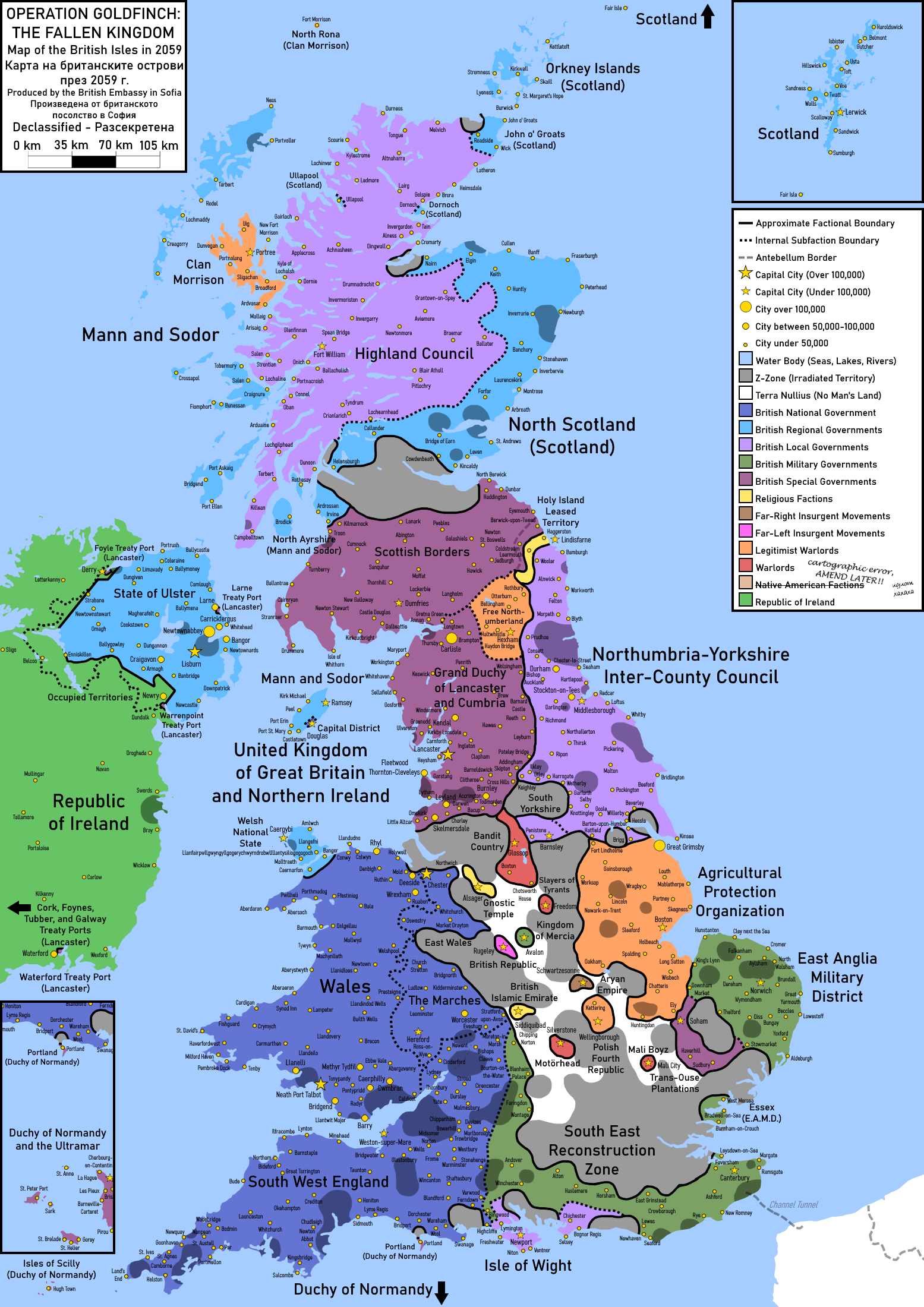
Map Guide
As part of Operation GOLDFINCH, a map drawn by the expedition’s cartographer was commissioned. This map is suitable for widespread dissemination in Bulgaria and beyond.
You may note that this map was created following the American pattern of official maps, fashioned after the Task Force PHOENIX situation maps, themselves derived from the Battista administration’s original nuclear safety maps. We came into some of these very impressive maps during our 2054 visit to the United States (Elizabeth City) and have adopted the template.
I can personally attest to the quality of Operation GOLDFINCH’s cartographic component, which despite limited resources appears to be almost perfectly accurate to the reality on the ground. Faction borders did not change across 2059, and we expect this map to continue being accurate for the short-to-medium term, barring the eruption of any new conflict.
For ease of understanding, a detailed legend to deciphering the map is below.
Borders
Solid lines indicate the approximate boundary of a faction on the map. This can range from actual codified borders to a vague sphere of influence.
Dotted lines indicate the internal boundaries of a faction. This could denote the borders of autonomous regions under the Douglas government, the boundaries between a faction’s internationally recognised territory and its occupied territories, or a faction that borders some kind of satellite regime that is closely associated with it.
Light-grey dashed lines indicate the pre-war international and sub-national boundaries of the United Kingdom: between its four countries, along with the pre-war British-Irish border.
Physical Features
Large stars represent factional capitals with populations above 100,000 people. This includes the capitals of subfactional regions, such as regions directly administered by the Douglas Government, along with the capitals of client states and occupied territories of larger powers.
Small stars represent factional capitals with populations under 100,000 people.
Large circles indicate non-capital cities with populations over 100,000 people.
Medium-sized circles indicate non-capital cities with populations between 100,000 and 50,000 people.
Small circles indicate settlements with populations below 50,000 people. All of these cities have over 1000 inhabitants. This list is not exhaustive, as there are a large number of settlements over this size that were not included for reasons of expediency.
Pale blue indicates bodies of water: seas, lakes, and major rivers.
Dark-shaded regions represent Z-Zones. Due to the turmoil over the last thirty years, while many of these are at or rapidly approaching the state of habitability, they nonetheless remain mostly, though far from totally uninhabited. Some are terra nullius, though others are contained within the borders of a specific faction.
Faction Key
Dark Blue: United Kingdom: UK-Douglas Government
These are regions of Britain administered directly by the internationally recognised British government in Douglas, the fifth in a series of British governments directly descended from the pre-war British government. The Douglas government exerts limited authority in its directly administered territories, which are self-governing to a degree.
Light Green: Republic of Ireland
The Republic of Ireland, with its capital in Cork, along with the territory it occupies in pre-war Northern Ireland.
Light Blue: Devolved Governments
These are the devolved governments of Scotland, Wales, Northern Ireland and the Crown Dependencies that have persisted since the end of the war.
Light Purple: Local Governments
These are surviving county governments that are mostly autonomous. County governments all over Britain survived and were left to fend for themselves in the immediate aftermath of the war, but most were quickly reintegrated into larger states. This category also includes the Northumbria-Yorkshire Inter-County Council, which is highly autonomous and comprises several surviving county governments.
Green: Military Factions
These are factions led by surviving elements from any branch of the armed forces. (Though not necessarily that of the United Kingdom!)
Brown: Right-Wing Ideological Factions
There is one explicitly right-wing ideological faction in Britain, although Free Northumberland, the Duchy of Lancaster, and the Douglas government all arguably qualify as right-wing factions.
Pink: Left-Wing Ideological Faction
The sole explicitly left-wing ideological faction in the British Isles is the British Republic, the last remnant of the 2057-8 British Republic in Worcester, currently based in Rugeley, Staffordshire.
The NYICC and the Duchy of Lancaster also arguably qualify as left-wing factions.
Yellow: Religious Factions
These are factions organized around a religious movement. There is one Christian religious faction in Britain, one Islamist regime and one Satanist/Gnostic one.
Orange: Legitimist Warlords
These are warlord factions that are centered around some kind of legitimising institution, in which power is maintained through something greater than sheer brute force. All examples of this in Britain are states built around newly-created post-war institutions, such as a militia, a hastily assembled government-in-exile, a neo-feudal assembly of farmers and a single landowning family.
Red: Warlords
These are the petty warlords, criminal gangs, vigilante gangs, escaped EAWs, gang alliances, and other factions that have no effective claims to legitimacy, however remote. These factions tend to lack organised institutions, and authority is maintained almost solely through armed force and coercion, though they run the gamut from relatively benign to truly despicable.
Tan: Native American Factions
Why is this here? [Note to editor, please update GOLDFINCH map to exclude North American-specific features from PHOENIX template map.]
Dark Purple: Special Cases
These are any and all factions that do not quite belong to previous categories. This qualifier is mostly reserved for “post-warlord” states: warlord factions that have grown sufficiently advanced and sophisticated that they can no longer simply be described as legitimist warlords. This first category includes two of Britain’s biggest success stories, the Grand Duchy of Lancaster and the Duchy of Normandy.1
The remainder of these include governments that simply do not fit into any other category. This is a diverse group, encompassing a corporate agricultural settler colony under the loose oversight of two squabbling regional governments, and occupied territories in Scotland and Ireland under foreign administration.
Index
Here is a collection of links to other Fallen Kingdom entries, posted in chronological order.
Teaser
Introduction [You are here]
Antebellum Britain
The War to End All Wars
See Also: The Fallen Continent, an American companion series.
Ironically, neither of these are monarchies, and both are functionally independent from Douglas.
 | A guest post by
|
Awesome, can't wait to see this universe expand
I notice Lancaster is mentioned as being both a right-wing and left-wing faction. Deliberate or typo?